
We're all just trying to keep it between the lines.
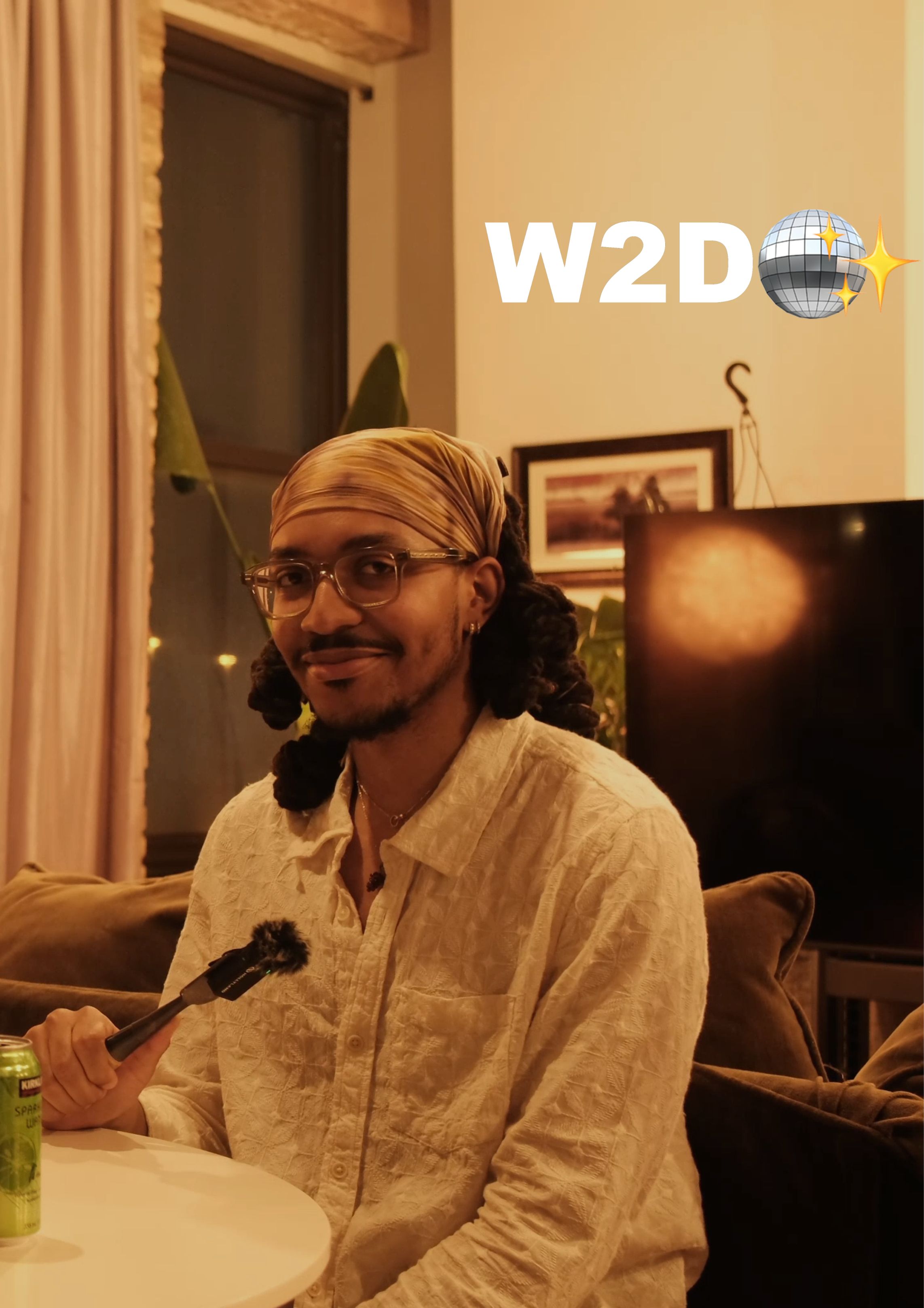
On a beautiful Thursday evening in Chinatown, Chicago, IL, I sat down with a dear friend, Jared Seller Bryson, to discuss his latest book, For Posterity 2 (2026), and the creative practice he's so meticulously built.
Thalia: Before we get into the whole project, I would love for the folks who are listening who don't know you, for you to introduce yourself — who you are, where we are in the world right now, and how For Posterity 2 came about.
Jared: I am Jared Bryson, Seller Bryson. I'm a multidisciplinary artist, writer, woodworker, DJ, photographer, among other things. It's a beautiful Thursday. The sun has set upon my home here in Chicago, and I've been presented with an opportunity to work through challenges all week to bring this to life.
For Posterity 2 is the next volume of For Posterity, the book project, and with that, it's not just volume two, it solidifies For Posterity as a practice. Soon as you get from one to two, one time it was a cool little thing. Two times, we're onto something.
T: I'm really curious about the role community played as we were working on For Posterity 2. I heard there was a collaboration around illustrations, so I'd love to hear how that came about and what that looked like for you in this process.
J: In the creation of the images and in the curation, the designing and creating of the book — there's a lot of collaboration. The images themselves rely on me engaging with subjects, usually people who are close to me. In putting the book together, I knew especially around design that I wanted to bring in other people — not because I couldn't design it myself, but because it would be so much better if other people whose expertise and craft that is could contribute. One of my friends, Ibrahim from Morehouse, had a logo designed for him back around 2021 or 2022, and I was like, "Man, this is a nice logo." He said, "Oh, my cousin did it." I saved down his cousin's IG and saw his style, and I thought, someday this is going to come in handy. It clicked with this project. We collaborated on four illustrations in volume two that serve as a third medium in the book — alongside photographs and writing — that carried a message. And by virtue of me knowing my girlfriend, I was connected with the editor of volume two, Grace. She was the most experienced person in this realm of publishing and bookmaking that was in proximity to me, so she graciously lent her time and eyes on reviewing, sequencing, editing — all of that.
T: Working with editors means people are seeing the uncut, unedited parts of your work — things that require vulnerability to share. How did vulnerability play a part in creating this book?
J: The role of an editor — especially with images — people feel like they can comment on your photos. But the feedback you get from them is probably not what you want if you wanna push your project forward. So if you have a good editor, and my style is: let's rip the Band-Aid off, just give me the feedback. Vulnerability in the context of this book looks like, "Hey, here's this sequence. What do you think? Here's an image that has some personal connection to me even above the other ones." An example — I have this image of my former roommate, Jameson. He's peering through the doorway. This is on Valentine's Day in 2022, and he's holding a box of chocolates. The photo is hella blurry, and I had yanked it — it wasn't even in my final pile of images at first. But when I went back and followed this thread of connection and romantic connection, I found that image, and it was super special to me. The first time I showed it to Grace, she was like, "Yeah, it's not doing anything for me." And I'm like — dang. So you have to tango with that. Whether you follow that feedback or not, you have to take it and do something with it. I always use this phrase of "I'm married to this, I'm not married to this" with design choices, sequencing choices, image choices — and there's gonna be some breakups.
T: I'm reminded of many parts of my writing that I thought I was married to, but when I saw comments on them, I was like, "Oh, maybe this doesn't serve the story." Shout out to people who use their red pen liberally and authentically, but also generously.
T: I would love to hear about the process. Were you taking photos for the book, or were you just taking photos and curation came after?
J: Ever since I started the project in 2021, it's a mix of curation and creation, and they influence each other. Usually what I do is take my camera throughout my life, I'm taking pictures, and then sometime later — weeks, months, years — I return back to those images with whatever my present mind and present self can bring to them, and then I begin to curate. It's really mostly a process of chipping away at the stone, chiseling away till you can reveal what's underneath. And in addition to that, there starts to be a conversation: what I am chiseling away at in 2026, looking at images from 2022, will influence what I make images of in 2026. So they're all connected. It's circular. For the most part, I'm sitting on a pile of ten, twenty thousand images from a year, and I'm just chiseling away — "Okay, what themes can we pull from this year?"
T: And when did you decide to do FP2? Was that always the plan?
J: When I first started volume one, the plan was to do it every year — a complete, comprehensive archive of my life, every year getting a book. After doing the first one, I was like, no. There's no way. And here I am four years later just getting to 2022. The conclusion I came to was there is a way to still capture comprehensively without the flywheel of needing to hit a book every year. The process I've designed is to continue to capture all the time and continue to have some box or constraints to put the images in. Volume three will be from 2023 and 2024 — two years — and it will increase as time goes on. It'll still be comprehensive, I'll still have the constraints of some period of time, and all that trickles down to: what message, what ideas am I pulling from this collection?
T: 2022 was a long time ago — four years is a whole college degree's worth of time. How was it to curate a comprehensive review of a life you lived four years ago?
J: There's a sort of rhythm that developed by chance. 2022 was my first year working post-grad school — first year of adult school, if you will. And four years later, here we are. Such an interesting block of time to look back on. I've been able to look back via the images, via my journal entries, and not get lost in the sauce of the past. It's vivid, but it's not sucking me in. Partially because many of these things have passed the statute of limitations — I either cannot do anything about it, or if it's about people, I might not even talk to them anymore. I can look back at the memories, sometimes reading them off the page of my journal, without it stinging like a hot stove. I can see the temperature, but I don't have to touch it. I've been surprised to see the balance of living so intently — on purpose going back to the past to do this curation — but it's not interfering. It's only enhancing my current life.
T: You mentioned having a reverence for hard work, and the quote I pulled was: "Grind is different from the deep end." With FP1 there was no gallery, no artist talk. This time there's a whole world around the release. What are you learning about yourself from this experience?
J: Back in January, around my birthday, me and some friends did vision boards. One of the things I pulled — the words said, "Big boy, big bites." I think the separation between the grind and the deep end is discomfort. Risk. Making the book itself — I've literally done this before. The physical format is exactly the same size as volume one. So there's some comfort there, some parameters. But then there are things I wanted to take risks on — to elevate, to have new experiences, to explore. That is bringing people together around the launch, the artist talk, engaging with people in a different way. And back to the vulnerability point — vulnerability is the fuel of this risk. When you ride your bike in the middle of the street, you put up your physical health. You get fun out of it. In this case, with the book, with doing this interview, with doing the artist talk, the exhibition — I put up the vulnerability of more eyes seeing it, different eyes seeing it, seeing it in a different way. And from that vulnerability, I get a deeper connection with actual people — to myself and to the art. That is me taking a risk, using vulnerability as my chips, and I hope to get out some deeper connection.
T: People want to know — how do you balance your day job and your practice, especially in this economy?
J: The biggest tactical thing I do is setting aside certain days. Definitely in 2025, Tuesdays were: I will be working on my craft. Craft Tuesday. For this year, it's been the book. I had to put DJing down, put woodworking down. Tactically: set aside a day and get into the rhythm of, "This is what I do on this day, even if it's a little bit." But even more nebulously, there's an identity component. The practice and the identity feed each other. You do the thing more and you're like, "No, I am an artist. I am a bookmaker." You start to have projects that literally exist, and you become more undeniable. Who's gonna tell me I'm not a bookmaker? This is a book.It's made.
T: How do you navigate knowing when to put things down to focus on one thing? At what point were you like, "If I'm gonna get this book done, I need to lock in"?
J: The decision to put things down was much easier because I do not view myself as a fraud in any of those areas. Period. When you have a fledgling interest in something, if you put it down, the flame is so small, you're afraid it'll die. But I know myself — I may put it down now, and it could be three years later, but I'm going to get back to it. DJing is actually one of those. I got my decks in 2022, didn't touch them for a year after moving to Chicago, then went to Oakland, got on some open decks, came back, met my man Fred, he invited me to Low Volume — and that's an example of putting it down for a year and having enough foundation to get back into it. It's much easier to put stuff down when you know it's temporary. If I stop DJing for three months, but I've got 25 mixes up — this is just a break. Build the foundation in those things so it feels like taking a break, not quitting. And if you're bad like that, just say, "I'm gonna get back to it," and then follow through on that.
T: Is there anything you'd like to share that I didn't ask?
J: The deep end thing. I want to share more about that. One thing that I write about separately from the For Posterity practice is energy management — and I really don't mean to get woo-woo. Literally, I have a practice where if I come up to you, are you at a one, a two, or a three? Two is your regular level of energy. Three is more than normal. One is less. I am so aware and so intrigued by how I've been feeling energy-wise the last couple of weeks with the book. Not the book itself — the container is the same, so I can power through that. But everything around it: the artist talk, the exhibition, frames, prints, all these things I'm stretching myself to do. This is using my energy in a totally different way. We talked about riding a bike in the middle of the street — there's discomfort there, but it's a known. This is an unknown. And it's been so long since I've experienced that. It ended up grounding me, but it could have very easily had me spiral — "What's going on? I don't know how to do this." I just wanted to name that.
T: This is a big deal. People are coming in from other states to be a part of this experience. I can't wait to be there.
J: Looking forward to it.
T: Where can people find you, the book, and everything you've got going on?
J: You can find everything at jaredsbryson.com — For Posterity, my other photography work in fashion and basketball, my writing, and much more.

.jpg)
.jpg)